Concept Analytics Lab

Five years on: a new Junior Research Associate project asks how we remember Covid-19

June 2026

We are delighted to announce that a new Junior Research Associate project is about to begin at the Concept Analytics Lab. It will be carried out by Henry Parish, who has just finished the second year of his degree in English Language and Linguistics at Sussex, and supervised by the Lab’s director, Dr Justyna Robinson. The scheme is open to undergraduates across the whole University and fiercely competitive, so securing a place is an achievement in itself. Over eight weeks this summer, Henry’s project will ask a deceptively simple question: how is Covid-19 remembered five years on, and what should policymakers learn from those memories?
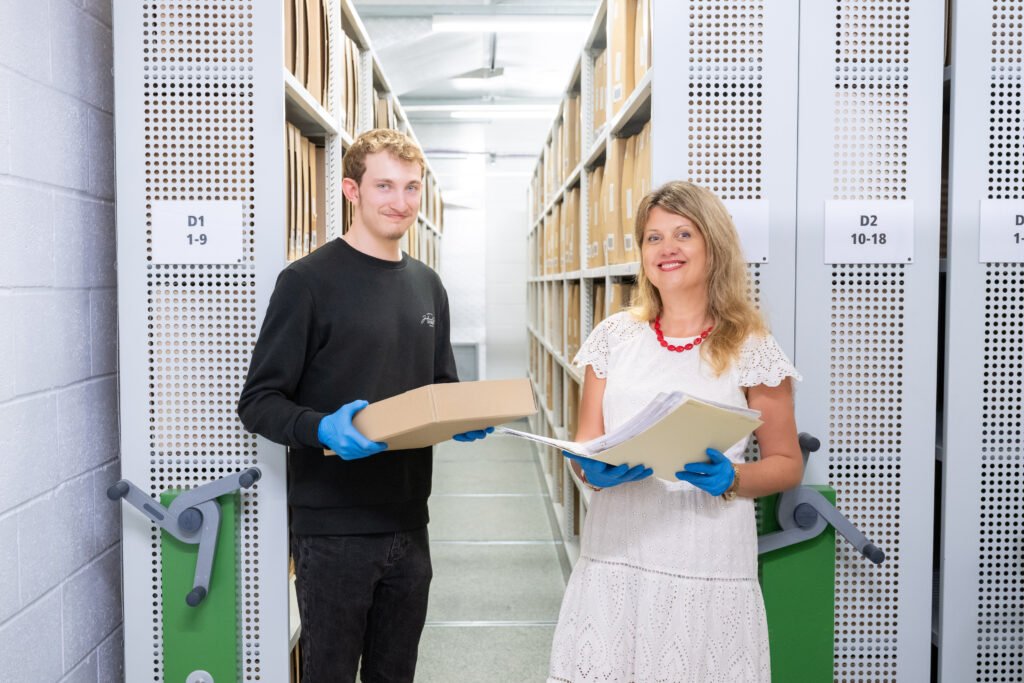
Justyna and Henry in the Keep which holds Mass Observation Archive, looking though materials submitted to “Covid-19: 5 years on” directive

Why this project, and why now

The 2025 National Risk Register places pandemics at the top of the United Kingdom’s risk matrix. Spillover risk, climate change, globalisation, and viral evolution make another one a live prospect. Medical advances are only half of the preparedness picture. The other half is public health policy, and policy depends on understanding how people actually experienced, interpreted and remembered the last pandemic.
The project draws on the Mass Observation Project, the life-writing archive held in the care of the University of Sussex, in which a panel of volunteer observers writes at length and in their own words in response to open, high-level prompts. The result is exactly the kind of rich, narrative data that has been under-used in accounts of public attitudes to the pandemic.

Three moments, one method

The project centres on the Mass Observation Project’s 2025 directive, “Covid-19: 5 years on”: 216 responses of around 1,000 words each. The Lab has already built two Mass Observation collections into searchable online corpora: the 12th May diaries submitted between 2010 and 2019, which capture the texture of pre-pandemic life, and the diaries written during the first United Kingdom lockdown in 2020, which capture the pandemic as it was being lived. Setting the 2025 directive against both gives a pre-, peri- and post-pandemic sequence, and lets the project trace not only what people say now but how far it has drifted from what they said then.
Additionally, the project will use the Mass Observation Project’s socio-demographic metadata, including gender, region and occupation, to ask whether memory of the pandemic is socially shared or socially divided. A panel of observers who wrote across all three periods will also be read closely, so that individual accounts from 2020 can be held directly against the same writers’ recollections in 2025.

Concepts, not words

This is where the Lab’s own research programme comes in. Corpus linguistics has traditionally taken the word as its unit of analysis. The Concept Analytics Lab has spent several years arguing, and demonstrating, that the more instructive unit is the concept: a meaning represented by a network of semantically related words. That argument was set out in Robinson, Sandow and Piazza’s 2023 paper in Frontiers in Artificial Intelligence, developed further in a chapter on conceptual variation in Sociolinguistic Approaches to Lexical Variation in English (Routledge), co-edited by the Lab’s own Rhys Sandow, and is now embodied in the Lab’s Concept Cruncher tool, currently the subject of a methodological paper in preparation.
Concept Cruncher profiles a given dataset against a baseline and renders the result as a sunburst visualisation, with the most characteristic concepts highlighted. It works as a compass rather than a conclusion as it points the analyst towards what is distinctive, such as regulation in the peri-pandemic data, and any concept it surfaces can then be profiled in its own right. Discourse analysis does the rest of the work, unpacking how those concepts are framed and evaluated in the texts themselves. Computational scale and qualitative depth, in other words, doing what neither can do alone.

What will come out of it

Two things, both public. A briefing paper on the Lab’s website translating the analysis into evidence-led recommendations for pandemic preparedness, and an article in The Conversation. The project sits at the intersection of linguistics, sociology, history, the digital and medical humanities and public policy, and does what the Government’s digital transformation agenda calls for which is turning archival material into a digital resource whose meaning can inform policy.
For the Lab, it is another chance to put our methods to work on a question that matters. For Henry, it is a first taste of original research, stakeholder engagement and academic writing. We will be sharing findings as they emerge. Watch this space.